Six days, four stops and plenty of impressions: Martin and Hannes spent a week exploring the area around Bogotá, Colombia’s capital. Their journey took them through the regions of Cundinamarca and Caldas, right into the heart of Colombia’s coffee-growing world. Along the way, they met passionate farmers, visited research and development projects, and gained fascinating insights into the future of coffee production. It was an intense and varied trip, but above all, one filled with inspiring encounters with our partners. When Martin and Hannes returned to Berlin, they brought back not only a wealth of new impressions, but also plenty of inspiration and ideas.
1. Stop Visiting the FNC and the Cenicafé research centre
The first stop on Martin and Hannes’ journey is the Federación Nacional de Cafeteros de Colombia (FNC). The FNC is Colombia’s largest coffee exporter and one of the key institutions in the country’s coffee industry. For several years now, it has had a dedicated team focusing specifically on specialty coffee. We also regularly source coffee from FNC members, including our popular Sierra Nevada.
For Martin and Hannes, the visit is a great opportunity to learn more about our collaboration with the FNC and discuss potential opportunities for the future. The FNC has an exceptionally extensive network and access to coffee producers in virtually every region of Colombia. This means it can help us source a wide range of coffees – from organically certified coffees to high-quality microlots.
From there, they continue to Cenicafé, one of Colombia’s leading coffee research centres. They are given a tour of the experimental fields lasting more than two hours.
There is plenty to discover: dozens of different varieties, plants and impressively large coffee trees. Cenicafé has an enormous collection of different coffee species and varieties and has been working for decades to develop coffee plants that are both new and more resilient.
One particularly fascinating aspect is the breeding programme. Just a few months earlier, Cenicafé had introduced the new Castillo 2.0 variety. It combines genetic material from around 40 different varieties, including plant material from Ethiopia. By comparison, Castillo 1.0 is based on around 20 genetic lines.
The aim is to combine resilience, productivity and high coffee quality. However, it takes many years before a new variety can actually be grown and harvested on farms. In our article on the work of World Coffee Research, we take a closer look at just how complex and time-consuming the development of new coffee varieties can be. Research into Castillo 2.0 began around 20 years ago – back when Nelly Furtado, James Blunt and Justin Timberlake were dominating the charts and Angela Merkel had just been elected Chancellor for the first time.
For now, Martin and Hannes can’t taste coffee from Castillo 2.0. The plants are not yet producing enough coffee. That makes the anticipation of the first cup all the greater.


2. Stop: La Vega Coffee, hospitality and a football match
After the research centre, the two continue their journey to Finca Valparaiso in La Vega. Does the name sound familiar? Earlier this year, we sold a particularly vibrant and clean washed Arabica from this farm.
Martin and Hannes get to spend two days and two nights on the farm where this wonderful coffee is produced – and finally meet farmer Marta Cecilia in person.
Marta came to coffee almost by chance. Around six years ago, she and her family had originally planned to set up a small hotel in the countryside outside Bogotá. They were then given the opportunity to take over an existing coffee farm with a small hotel. The family decided to go ahead and took on the property, embarking on an extensive renovation.
But then the pandemic hit.
While the hotel business effectively ground to a halt, Marta Cecilia increasingly turned her attention to coffee. What had started out as a side project grew into a passion – and eventually into a much more exciting and substantial business.
Martin and Hannes tour the farm and get an insight into how the coffee is processed. But their tour has to end a little earlier than planned that day: Colombia are about to play Switzerland in the World Cup. So the two of them watch the match together with the farm workers and coffee pickers in the farm canteen – a brilliant experience that will definitely stay with them.

3. Stop: Apuna Visiting our project partners
The third stop on Martin and Hannes’ journey is Apuna, the NGO of coffee exporter Siruma. The organisation is working on a project that we have been supporting since the beginning of 2026.
As Martin and Hannes have not yet had the chance to meet the team in person, the people behind the project are the main focus of their first visit. They visit the office, get to know the team and gain an insight into the organisation’s day-to-day work and its various activities.
On the second day, they head out into the countryside to visit the coffee farms themselves.
Apuna works closely with smallholder farmers, offering training on topics including gender equality and sustainable coffee farming. A key focus of the current project is improving soil fertility.
One product that is available as a waste product on every coffee farm plays a central role: coffee pulp. After the coffee cherries have been processed, the pulp is left behind as organic material and can be composted. However, the right infrastructure is needed to make this possible.
With support from Apuna, 50 smallholder farmers can now build their own composting facilities on their farms. The coffee pulp is transformed into a valuable fertiliser, which can then be returned to the fields.
This has several benefits. Farmers can improve the health of their soil while reducing their spending on agricultural inputs by around 20%. At the same time, the project is intended to serve as an example for the wider community: when other farmers see that the method works and actually helps to reduce costs, they will hopefully be encouraged to build their own composting facilities too.
Martin and Hannes visit two small farms whose owners are part of the project. The farms are located well away from paved roads and are part of local Indigenous communities. The encounters leave a particularly strong impression on both of them. At the same time, they highlight how important it is to develop sustainable change together with the people on the ground, so that they can continue the work independently over the long term.
We are very excited to see how the project develops over the coming months.





An update on the lasting impact of the earthquake (10.08.2026)
“Here in Caldas, the main harvest is just starting, picks up in September, and October and November are the peak months for picking. So the earthquake comes at an especially critical time.
Many of the affected families are now having to use resources and savings for food, housing, and urgent repairs that would normally be used to prepare for the harvest (paying farmworkers, making repairs on the farm, maintaining equipment and infrastructure, etc). Some people may even be forced to relocate or look for other work to earn money to repair what they lost, which could also make it harder for them to be present on their farms during the harvest.
There are also important farm activities that should be happening now, such as the second-half-of-the-year fertilization, that may have to be postponed because families’ financial priorities have changed after the earthquake. That could have consequences not only for this harvest, but for future harvests as well. For families whose livelihoods depend on coffee, recovering as quickly as possible is even more urgent because the earthquake happened just when they need to invest time and resources to secure their primary source of income.”
– Ximena, Apuna, Director of Sustainability.
4. The final Stop: Eduardo's Farm Specialty coffee und regenerative agriculture
To round off their trip, the two spend around 24 hours on Eduardo’s farm, a friend and supplier of our friends at the British roastery Origin Coffee.
Eduardo is a third-generation coffee farmer based in Caldas. Three years ago, he took over the family farm from his mother. He quickly realised that, in the long term, there was only one way to run the farm successfully: by consistently specialising in specialty coffee.
Since then, he has invested heavily and tried out new approaches. He has planted new coffee varieties, upgraded his facilities and worked intensively to improve the quality of his coffee.
At the same time, Eduardo is deeply committed to sustainable coffee farming. By using organic materials, he has significantly improved composting and soil conditions on his farm.
Eduardo has also brought a biologist onto the farm and planted numerous native trees. The increased biodiversity is intended to help make the farm more resilient to the effects of climate change.
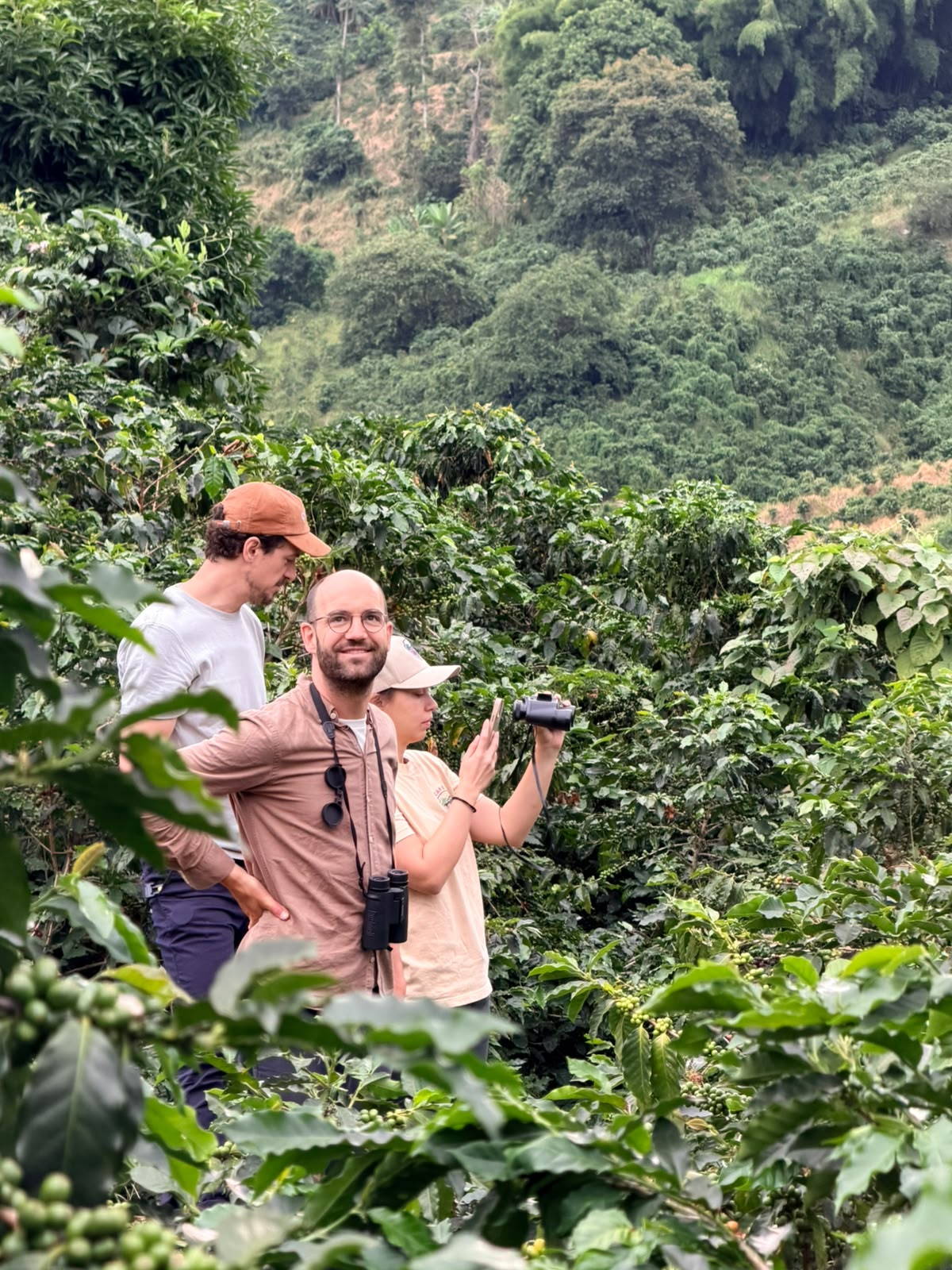
Early in the morning, Martin and Hannes head out on a farm tour with Eduardo – with a spot of birdwatching along the way. It is a striking demonstration of just how diverse the ecosystem around the farm is, and of how much Eduardo has already achieved.


Conclusion Back to Berlin with plenty of ideas
During this short but eventful trip, Martin and Hannes gained insights into many different aspects of coffee production in Colombia. They learned more about the work of one of the country’s most important institutions, delved into research and the breeding of new coffee varieties, experienced everyday life on coffee farms, and saw first-hand how projects focused on the future of coffee farming and social sustainability are being put into practice.
Above all, though, it was the people who made the trip so special: the researchers at Cenicafé, Marta Cecilia and her family, the teams at Apuna and Siruma, the farmers they met along the way, and Eduardo with his vision for the future of his farm.
Colombia showed Martin and Hannes just how much potential lies in long-term partnerships, research, regenerative agriculture and direct exchange with coffee producers.
Eventually, the two arrived back in Berlin, bringing plenty of positivity and a healthy dose of inspiration with them.
Want to find out more about their Origin Trip? Head over to our Coffee Circle Instagram account to see first impressions from this year’s trip in the “COL 26” highlight. The next chapters of this story will soon be making their way into your cup.



With every cup of coffee, you support our projects in Ethiopia and other coffee-growing regions. Together with you, we’re helping to improve the lives of coffee farmers and their families!