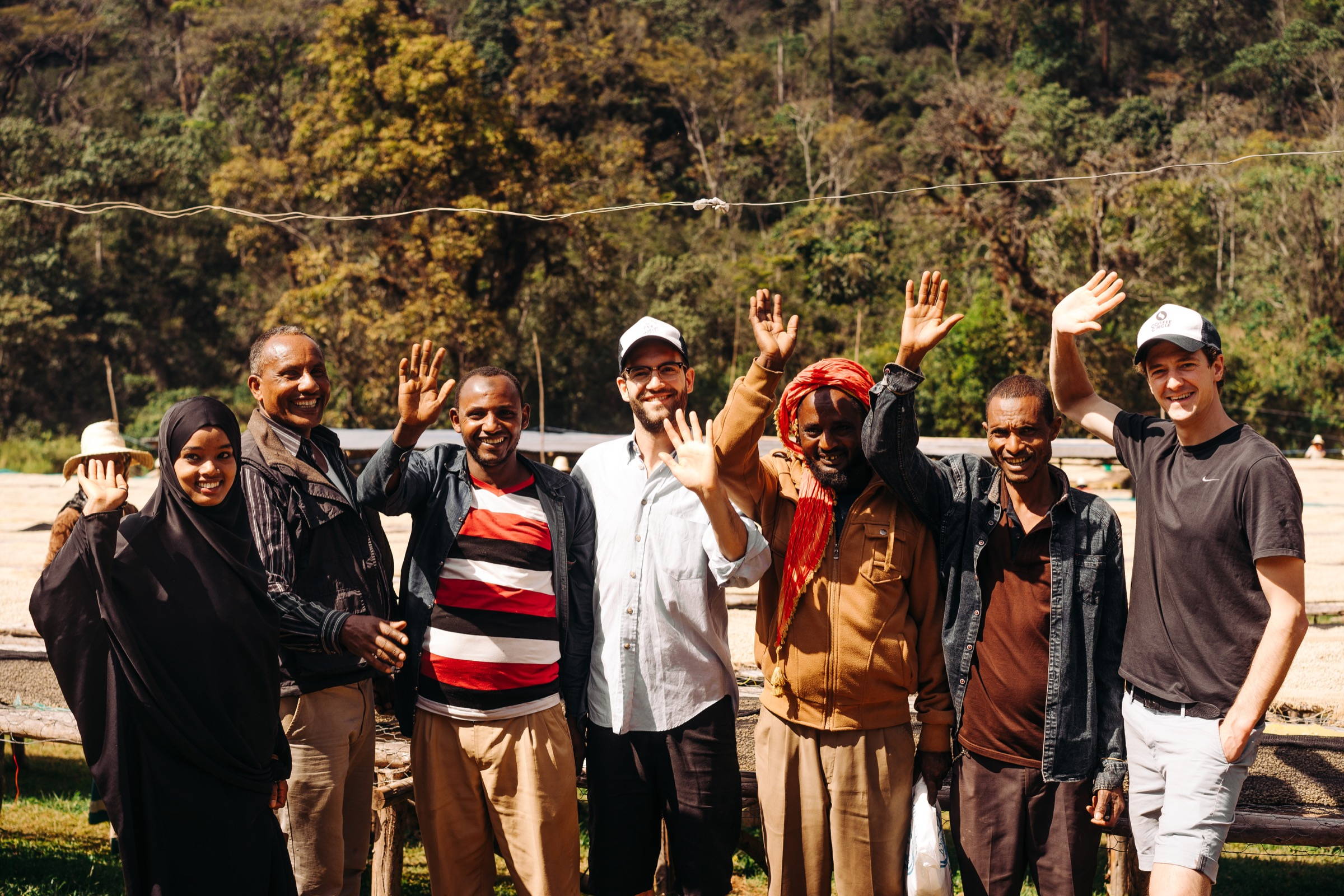
Addis Ababa Airport in Ethiopia is a good place to pause for a moment. Martin and Hannes have had a busy week in February – packed with intense, insightful conversations and lots and lots of coffee.
Ethiopia is the most important coffee country for Coffee Circle. This is where our origins lie, and we still source most of the coffee for our single origins and blends from here.
Day 1 and 2 Selecting the Best Ethiopian Lots
At this time of year, the harvest in Ethiopia is largely complete. This means that Hannes and Martin’s focus on this trip is on meeting long-standing partners in Addis Ababa and tasting the fresh harvest in order to select the best lots for the coming season. The challenge of this trip lies in the short time the two have planned for it this time.
- The start of the week is nevertheless relatively relaxed. Together with Ansha and Moata from CoQua, they taste around twenty to thirty coffees on Monday to get a first impression of this year’s qualities.
- On Tuesday, things get a bit more intense. Martin and Hannes taste around eighty coffees in a single day, most of them in the late afternoon and early evening. It’s a sensory experience that pushes their limits and is physically demanding, even for experienced coffee professionals. But the intensity pays off. They find the lots they were looking for and leave the cupping tables eagerly anticipating the new harvest.
Thanks to long-standing local partnerships, a selection of coffees that the two wanted to taste had already been discussed in advance. Which coffees ultimately end up on the final cupping table is determined gradually over the preceding months. Among other things, information on the development of the harvest, the weather, prices and the political framework conditions of the origin region flows into this process.
We learn that, as of this year, the Ethiopian government has set very high minimum prices for the purchase of coffee cherries. This has had a major impact on the country’s exports. Following a record harvest last year, the volume of coffee is expected to be lower this year, but the quality in Sidamo and Yirgacheffe is said to be better. For Martin and Hannes, this is confirmed during the cupping: the naturals they select here for our limited-edition coffees are particularly lively and expressive. The coffees from the Limu region, in the west of the country, surprised both of them very positively. They were among the best Martin and Hannes tasted this week in terms of flavour. They were also more moderately priced – another important criterion, especially given the recent sharp rise in global green coffee prices.


Day 3 and 4 Rwanda: Partnership that makes a difference
After Ethiopia, the journey continues to Rwanda – a first for Coffee Circle. It is our first trip to this country of origin, so curiosity is high. On site, Martin and Hannes meet our partners from Muraho, who have already made coffees such as Rugali and Muraho possible and have been specifically supported by the Coffee Circle Vision Fund I. During their stay, it becomes clear time and again that this is a partnership between equals.
The first day takes them to the Nyabihu region in western Rwanda, to the Shyira washing station, which is located not far from the Vunga station. The harvest has only just begun, so only sun-dried coffees have been produced so far. It is particularly impressive to see the progress that has already been made through joint investments. Agricultural scientists have been hired and trained, demonstration farms have been set up for young farmers, and regular visits to the farms have been established. There, farmers learn specific ways to increase their yields and make their fields more resilient to climate change, for example through organic fertilisation or mulching the soil. This enables coffee cultivation to become a sustainable livelihood for farmers. The impact is also clearly visible at the washing station itself. A new water filtration system not only provides employees with clean drinking water, but is also available to the surrounding population.
On the second day, Martin and Hannes travel further south-west to Nyamasheke, where they visit the Kilimbi and Rugali stations. Both places make a lasting impression: everything is professionally equipped for the production of the very finest coffees. The discussions with the agricultural scientists, whose jobs were created with our investments, are particularly memorable. It becomes clear that the measures communicated are not only explained to the producers, but also consistently implemented in practice.
In an open discussion with the farmers, Martin and Hannes learn how much the mood has changed in recent years. Rising coffee prices have made cultivation an attractive business again. This motivates not only existing farmers, but also many young people to return to coffee production. At the same time, new coffee plants are being cultivated, in some cases replacing other crops (e.g. maize), in the hope of long-term stable incomes.
A special project is currently underway at the Rugali station. Muraho is building a large, environmentally friendly system there to treat the wastewater from the washing station. This pilot project is intended to significantly reduce environmental impact and will be expanded to all stations operated by Muraho in the coming years.






Conclusion
At the end of this journey, back in the hustle and bustle of Addis Ababa airport as they transfer to their flight to Berlin, Martin and Hannes have come to a very clear conclusion: Muraho’s approach is convincing because it goes beyond innovation and training and actively gives farmers access to the coffee market. This aspect is crucial to sustained success and is therefore a cornerstone of all the projects we invest in: we want to avoid creating long-term dependencies on our involvement and empower local communities with the right tools so that they can achieve lasting independence and success.
For Martin and Hannes, it has been confirmed once again that Rwandan coffees are among the best in Africa and deserve to be shared even more widely with the rest of the world. That is why Coffee Circle will continue to deepen its partnership with Muraho and purchase coffees from Rwanda again this year.
The Ethiopian Arabicas have also impressed us once again this year. Martin and Hannes have worked hard to select some fantastic coffees – we can’t wait to roast them for you this summer.
Would you like to find out more about this origin trip? You can find first impressions of this year’s trip on our Coffee Circle Instagram account under the highlight ‘ETH 26’. The next chapters of this story will soon be landing in your cup.


Discover our coffees from Rwanda and Ethiopia



With every cup of coffee, you support our projects in Ethiopia and other growing regions. Together with you, we are improving the lives of coffee farmers and their families!