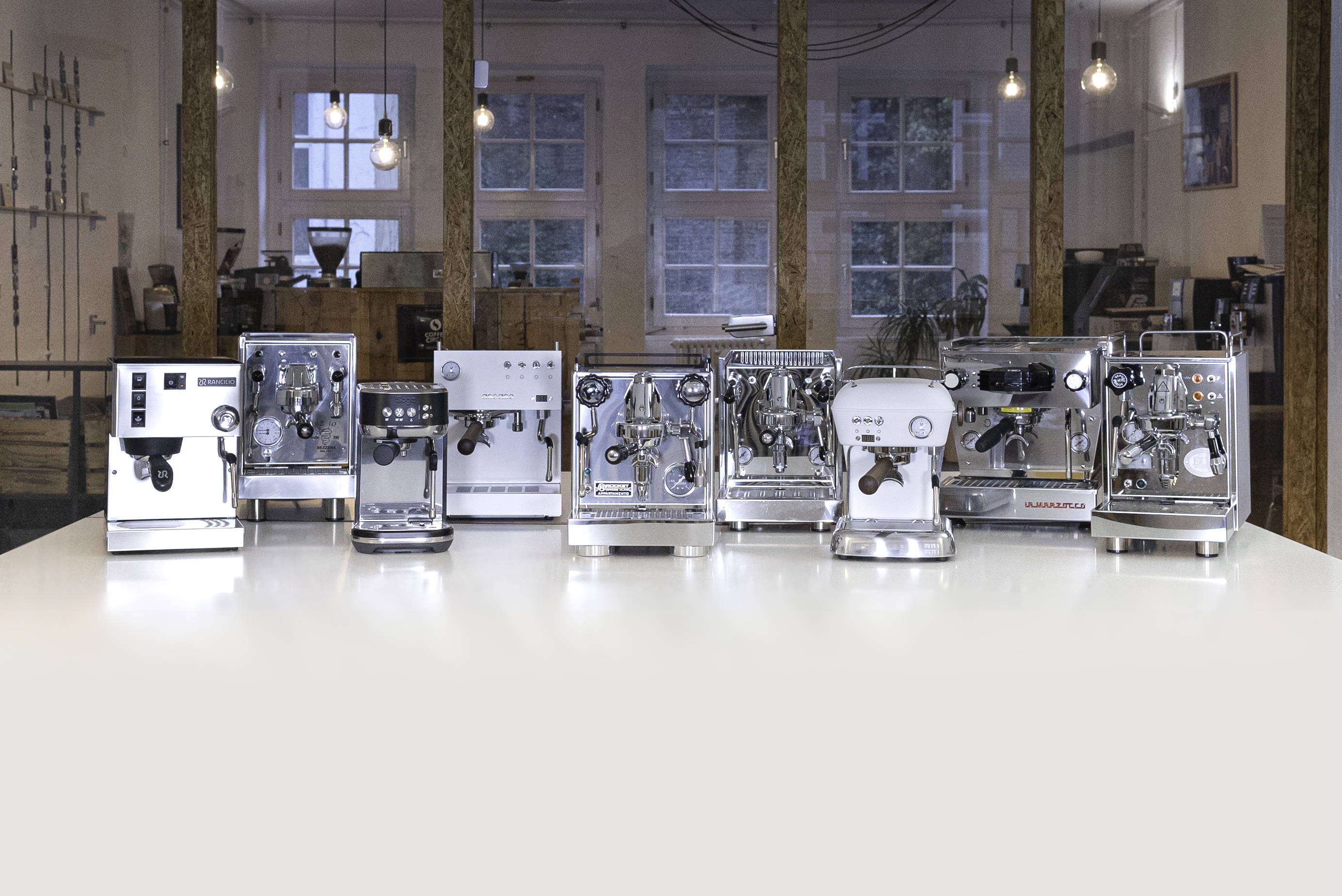
Espresso Machine Test 2026
The portafilter machine, often referred to as an espresso machine, is the shining centrepiece of any well-equipped kitchen. But with so many choices available, it’s not easy to decide. Which machine is right for you and your needs? We’ve tested 12 machines for you.
12 Portafilter Machines Put to the Test
Only got a minute? Our top picks at a glance
Our Top Pick for Beginners

Quickmill Orione For a quick espresso in the morning
Our recommendation for anyone who doesn’t want to miss out on really good espresso at home. The machine is robustly built and only reaches its limits when it comes to frothing milk. If that’s not a priority for you, you’ll get your money’s worth with the Quickmill.
Top Pick for Advanced Users

Bezzera BZ10 For value-conscious fans of milk-based drinks
The BZ10 is one of the most popular machines for home use. The electrically heated brew group ensures a quick heat-up time and consistent extraction. This dual-circuit espresso machine also impresses with its excellent milk foam results.
Top Pick for Professionals

Quickmill Rubino Best value for money of this test
We were impressed by the build quality and performance of the machine. The Rubino from Quickmill delivers exemplary espresso and has a compact design. We’d recommend it to all professional home baristas.
Portafilter Machines for Beginners
Portafilter machines for beginners are usually smaller and are primarily suited for making espresso. As they have only one boiler with a single water circuit, the machine takes a few minutes to adjust the water temperature between making espresso and producing steam. Because they feature simpler technology, they are easier and cheaper to manufacture.

Top Pick for Beginners: Quickmill Orione 3000 For a quick espresso in the morning
Type: Thermoblock Water tank: 1.8 l Heat-up time: 2–3 mins
The thermoblock machine is ready for use after just 2–3 minutes, which makes a significant difference compared to the typical 15 minutes. It is very well-built and robust for its price range and produces a decent espresso. If you want velvety milk foam, you should opt for a different machine. The milk becomes slightly watered down, and the process takes considerably longer than with any other machine. We have chosen this machine as our test winner due to its unbeatable value for money in this category. The machine offers an ideal introduction to the world of home barista.
- Value for money
- Short heat-up time
- High-quality build with copper pipes
Alternatives for Beginners

Rancilio Silvia Robust design with expansion options
Type: Single-circuit Boiler capacity: 0.3 l Heat-up time: 10–20 mins
With this cult machine, you can brew a good espresso after a heat-up time of 10–20 minutes. The machine builds up enough pressure to extract an espresso with a consistent extraction time. Drawback: It is not possible to check how many bar of pressure the espresso machine is using to force the water through, as there is no pressure gauge. The Rancilio Silvia has a large following amongst DIY enthusiasts, as it has a very simple technical design and can be repaired or modified by the user. This means the Silvia offers plenty of scope for future upgrades. Its robust (albeit rather unassuming) build quality also suggests it will be a long-lasting companion. Much like the Quickmill, the Silvia reaches its limits when it comes to milk froth. In comparison, however, the quality is better, and with a bit of practice it is possible to create a fine milk froth.
- Value for money
- Solid build quality and easy to tinker with
- Noise level; the machine was the noisiest in the entire test

Sage Bambino Plus An affordable machine for beginners
Type: Thermoblock Boiler capacity: 1.9 l Heat-up time: 3 s
The Sage Bambino Plus is recommended for those new to the world of espresso and for anyone who doesn’t have high expectations of their machine or espresso. It takes a little time to adjust the machine and grinder correctly, as the portafilter’s volume is very small. We were impressed by the automatic milk frothing function, which is easy to use and produces good milk foam, perfect for creating latte art. Our verdict: in terms of value for money, machines such as the Rancilio Silvia or Quickmill Orione perform better. The Sage Bambino Plus offers a good entry point, but after just a short time, the machine leaves you wanting more customisation options.
- Clear instructions and simple operation and cleaning of the machine
- Automatic milk frothing function
- Very short heat-up time
- Lacks high build quality
Profitec GO 2.0 A compact single-circuit machine offering plenty of control
Type: Single-circuit PID Boiler capacity: 0.3 l Heat-up time: approx. 7 mins
The Profitec GO 2.0 is a compact, single-circuit portafilter machine for beginners who don’t want to compromise on precise adjustment options when it comes to espresso. With its 0.3-litre brass boiler, PID temperature control and adjustable brewing pressure, it already offers many features usually found on more expensive machines. The new OLED display shows, amongst other things, the brewing time, making operation particularly straightforward, whilst its narrow width of just 21 cm means it fits even in smaller kitchens. When it comes to frothing milk, however, the typical limitation of a single-circuit machine becomes apparent. Anyone who mainly prepares cappuccinos and latte macchiatos, or wishes to serve several milk-based drinks in quick succession, must expect a waiting time. For pure espresso enthusiasts, on the other hand, the GO 2.0 is particularly appealing; those who regularly prepare several milk-based drinks will find a dual-circuit or dual-boiler machine more convenient.
- Precise PID temperature control, adjustable brewing pressure and OLED display
- Compact design and high-quality build
- Less convenient when making several milk-based drinks in quick succession
- Vibration pump is relatively loud
Portfafilter Machines for Advanced Users
Dual-circuit machines have two water circuits at different temperatures, which can supply brewing water and steam independently of one another. This eliminates the waiting time between making an espresso and dispensing steam – you can brew an espresso and froth milk at the same time.
Top Pick for Advanced Users: Bezzera BZ10 For value-conscious fans of milk-based drinks
Type: Dual-circuit Boiler capacity: 1.5 l Heat-up time: 10–15 mins
This machine stands out for its elegant design and can be instantly recognised as a Bezzera product thanks to its characteristic rocker levers. It features the electrically heated Bezzera brew group, which is easier to clean and maintain thoroughly than the E61. It produces an excellent espresso, whilst allowing milk to be frothed at the same time as the brewing process. The 1.5 l boiler provides significantly more volume for the steam, which escapes in a drier form than in single-circuit machines. You’ll have to do without other features, but the price speaks for itself.
- Value for money
- Top-quality espresso and milk foam
- Easy cleaning/maintenance of the brew group
- High-quality build
Alternatives for Advanced Users

Rocket Appartamento Our alternative to the BZ10
Type: Dual-circuit Boiler capacity: 1.8 l Heat-up time: 25–30 mins
The Rocket is a dual-circuit machine that delivers on its promises. Every espresso shot we pulled turned out superbly. We found it easy to quickly determine the correct grind size for optimal extraction. The high-quality build speaks for itself; weighing in at 20 kg, once set up, the machine isn’t going to move from its spot in a hurry. Every function has been well thought out and kept to a minimum. There is no PID control, nor any way to regulate the temperature or pressure. The length of the pull is determined manually via the brew lever – simple and precise. We recommend it to anyone looking for a straightforward and durable machine. For coffee enthusiasts who want to experiment with all aspects of espresso preparation, we recommend the ECM, which promises the same espresso quality and greater scope for adjustment, though this comes at the cost of slightly inferior milk foam.
- Value for money
- Intuitive and simple operation
- High-quality and robust construction

Ascaso Dream PID For lovers of design and cappuccino
Type: Thermoblock Tank capacity: 1.3 l Heat-up time: 1–2 mins
The Ascaso Dream PID is a real gem. The machine is very compact, making it a good choice for small coffee kitchens. The LED cup lighting, the portafilter handle and the wooden steam wheel are real eye-catchers. The Ascaso Dream’s aluminium construction makes it very light. However, this proved to be a drawback for us, as we had to hold the machine steady whilst securing the portafilter to prevent it from slipping. The built-in thermoblock is ready for use after just 1–2 minutes. With the Ascaso, extraction time, brewing temperature and pump pressure can be adjusted manually. Another positive feature is the steam wand for frothing milk. It packs a decent punch and can easily froth even large quantities of milk.
- Modern and compact machine design
- Excellent milk frothing results
- Poor stability due to its light weight

ECM Classika mit PID For espresso purists
Type: Single-circuit Boiler capacity: 0.75 l Heat-up time: 20–25 mins
The ECM is sure to set the hearts of pure espresso fans racing. This single-circuit machine impresses with its excellent espresso quality and simple, intuitive operation. Its understated design looks great in any kitchen, and the stainless steel body is beautifully finished. The water temperature and brewing pressure can be easily adjusted for optimal extraction. The machine is compact yet offers enough space for espresso cups and a scale to fit under the portafilter. The ECM performs less well when frothing milk, as it does not build up enough pressure for this, meaning the milk becomes watery unless you let the milk wand run for longer. A minor drawback that can be overcome with practice: care must be taken with the machine’s exterior parts to avoid burning your fingers.
- Intuitive and simple operation
- Many manual features such as PID and brew pressure control
- Classic and robust build quality
- Low steam power and watery milk foam
Portafilter Machines for Professionals
Professional espresso machines are characterised by consistently high-quality espresso. Dual-boiler machines have two boilers, allowing espresso and steam to be produced independently of one another and almost continuously, without any fluctuations in pressure or temperature.
Top Pick for Professionals: QuickMill Rubino Best value for money of this test
Type: Dual-circuit Boiler capacity: 1.8 l Heat-up time: 20–30 mins
The QuickMill Rubino impressed in our test with its excellent extraction results, ease of use and a high-quality, sturdy stainless steel housing. The only drawback is that the steam wand and hot water spout are not particularly well insulated, so a little care is needed here to avoid burning your fingers. The machine is easy to use and ready to go after just a 10-minute warm-up time. There is nothing further to say about the espresso preparation, which is very positive. We were very satisfied with the espresso extraction, were able to adjust it well, and the milk foam results are also impressive.
- Very good extraction results
- Compact and high-quality build
- Energy-saving mode available
Alternatives for Professionals
Profitec MOVE For those who like to experiment
Type: Dual-boiler, can optionally be used as a single-circuit machine Boiler capacity: 0.4 l coffee boiler / 0.75 l steam boiler Heat-up time: 10–17 mins
The Profitec MOVE is a compact dual-boiler machine which, despite its comparatively small dimensions, offers a comprehensive range of features. The 0.4-litre coffee boiler and the separate 0.75-litre steam boiler allow you to prepare espresso and froth milk simultaneously, whilst both temperatures can be adjusted individually. It also features an OLED display, programmable brew buttons, a timer, adjustable pre-infusion and a quiet vibration pump. Particularly handy: the steam boiler can be switched off if required, meaning the MOVE can also be operated as a single-boiler machine. It thus combines the compact dimensions of a smaller machine with the flexibility of a dual-boiler – only the advertised fast heat-up time proved less convincing in our test.
- Dual-boiler with independent steam and coffee boilers
- Extensive range of features
- Heat-up time in practice significantly longer than advertised

Ascaso Steel Duo PID Design and the pure flavour of espresso
Type: Dual thermoblock Water tank: 2 l Heat-up time: 2–3 mins
Our recommendation for anyone who places great importance on the appearance of their machine. The build quality and design of the machine are very high-quality and modern. A particular eye-catcher: the illuminated work surface. The machine is a dual-circuit model and is fitted with two thermoblocks, which promise a very fast heat-up time of 2 minutes. Adjusting the espresso settings was straightforward, and we were able to achieve excellent espresso results. The machine’s portafilter handles are the best we tested. If you enjoy drinking black espresso, this machine is perfect for you. We were also impressed by the milk frothing performance of the newer model (available from late 2022). Unlike its predecessor, the current versions have a significantly larger steam thermoblock and plenty of power. The machine is therefore now also recommended for fans of milk-based drinks.
- Compact design, fits well in small kitchens
- Quick and thorough cleaning process
- High-quality portafilter with wooden handle
- Impressive milk frothing too
La Marzocco Linea Mini R The machine for professionals!
Type: Dual-boiler Boiler capacity: 3.5 l steam boiler Heat-up time: approx. 9 mins
The La Marzocco Linea Mini R combines the distinctive design of the Linea series with modern technology and a significantly enhanced workflow. The dual-boiler design ensures high temperature stability whilst allowing for simultaneous espresso brewing and powerful milk frothing. New features include an integrated shot timer, brew-by-weight capability, a revised pre-infusion system and easily adjustable pump pressure control. The La Marzocco app also allows you to control the temperature, pre-infusion and other functions. For the brew-by-weight function, however, you’ll need the compatible La Marzocco Acaia scale, which communicates with the machine via Bluetooth. Nevertheless, the new Linea Mini R offers significantly more control over espresso preparation than its predecessor and, thanks to its iconic design and compact build, stands out as a machine that’s particularly well-suited to domestic settings. Anyone who values intuitive operation above all else is likely to appreciate the combination of paddle controls, the app and the functions that can be automated.
- Dual boiler with PID and excellent temperature stability
- Brew-by-weight option, shot timer and new pre-infusion system
- Powerful, insulated steam wand for working on multiple tasks simultaneously
- High-quality, iconic design with extensive app integration
Our Espresso Bestsellers


Why you can trust us
We love coffee and spend the whole day doing nothing else. Our journey into the world of coffee began in 2010, and we’ve learnt a great deal since then. From cultivation and roasting right through to brewing really good coffee, we’d like to share our knowledge with you. We only recommend products that we’d also recommend to our friends.

Who is this test aimed at?
Our espresso machine review is aimed at anyone who doesn’t want to miss out on really good espresso at home. This review is designed to help you find an espresso machine that suits your needs – no matter how much you know or how high your expectations are. To this end, we’ve tested a total of 12 machines: single-circuit, dual-circuit, thermoblock and dual-boiler models. We’ve covered them all.

How we tested the machines
Over several weeks, we put the espresso machines through their paces, as they say in product testing jargon. In the run-up to the test, we assessed which machines are particularly popular with our customers and tested these against new machines and manufacturers on the market, as well as well-known classics.
It was important to us to adopt the users’ perspective and take individual needs into account.
We assessed all the machines for their value for money, the quality of their extraction and milk foam, their build quality and stability, and their adjustment options. We tested the machines with both light and dark espresso roasts to identify any potential weaknesses during the espresso extraction process.
There is no clear winner. After all, not all machines are the same. Ultimately, it depends on what you’re looking for. Are you looking for a machine for a quick espresso in the morning, or one capable of making several cups of cappuccino in a row? Do you want good espresso at the touch of a button, or do you want to be able to adjust all the settings yourself? Unfortunately, we can’t answer these questions for you, but with this test we aim to give you an overview of which machine suits you best.