Manual Coffee Grinder Test 2026

The classic manual coffee grinder is much more than just a nostalgic item. It’s handy for when you’re on the go and is certainly capable of matching the grinding results of its electric rivals. Are you currently looking for a manual coffee grinder but can’t make up your mind given the wide range on offer? We’ve tested a few grinders for you and reveal our top picks here.
Which Grinders Did We Include in Our Test?
We tested a number of grinders in total. However, we’ll only be presenting our top three in detail here.
Which Categories Did We Compare?
- Build quality (20 %)
- Ease of use (30 %)
- Grind quality (50 %)
- Grinding mechanism
- Grinding mechanism diameter and material
- Grind settings
- Dimensions (including handle)
- Grinding speed
- Design
- Weight
In Short: Our Favourites
The Winner

Somewhat unsurprisingly, the Comandante MK4 has come out on top in our test. This grinder from a southern German company impressed in every respect: the sharp Nitro Blade® grinding mechanism, made of stainless steel, delivers an extremely precise and consistent grind, combined with very little ‘fines’ (fine coffee dust) across all grind settings. The Comandante impresses with a pleasantly smooth and fast grinding process that effortlessly handles even large quantities of coffee, making daily use particularly convenient.
Best Value for Money

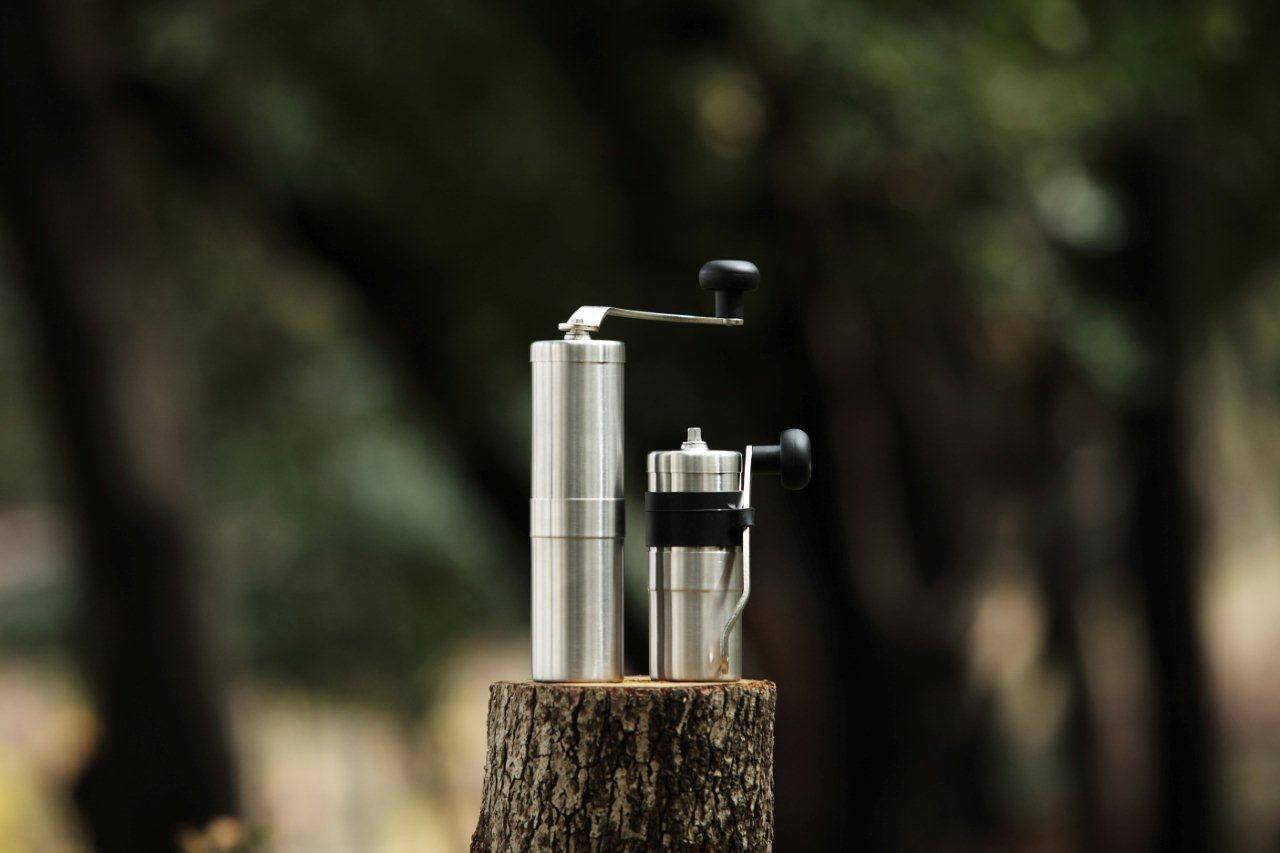
The Porlex Professional remains unbeatable in terms of value for money. It features a newly designed grinding mechanism made from coated ceramic and delivers a remarkably consistent grind for a grinder in its price range. The Porlex is well-made and consists almost entirely of stainless steel. Thanks to its rubber ring and smaller size, the compact version of the grinder fits more comfortably in the hand than the Porlex Tall. It’s also better suited as a small travel grinder.

Buying Guide: Coffee Grinders

Ceramic or Steel Grinders? The Important Differences
When it comes to grinder materials, the main choice is between ceramic and steel.
Ceramic grinders are characterised by high wear resistance, low heat build-up and rust resistance; however, due to their more brittle material structure, they are more susceptible to impacts or foreign objects.
Steel grinders, on the other hand, impress with their high robustness and durability, but can heat up more during grinding and are generally more susceptible to corrosion.
Which material is the better choice therefore depends primarily on the intended use and your individual preferences.
Our Favourites in Detail
Comandante MK4 Nitro Blade
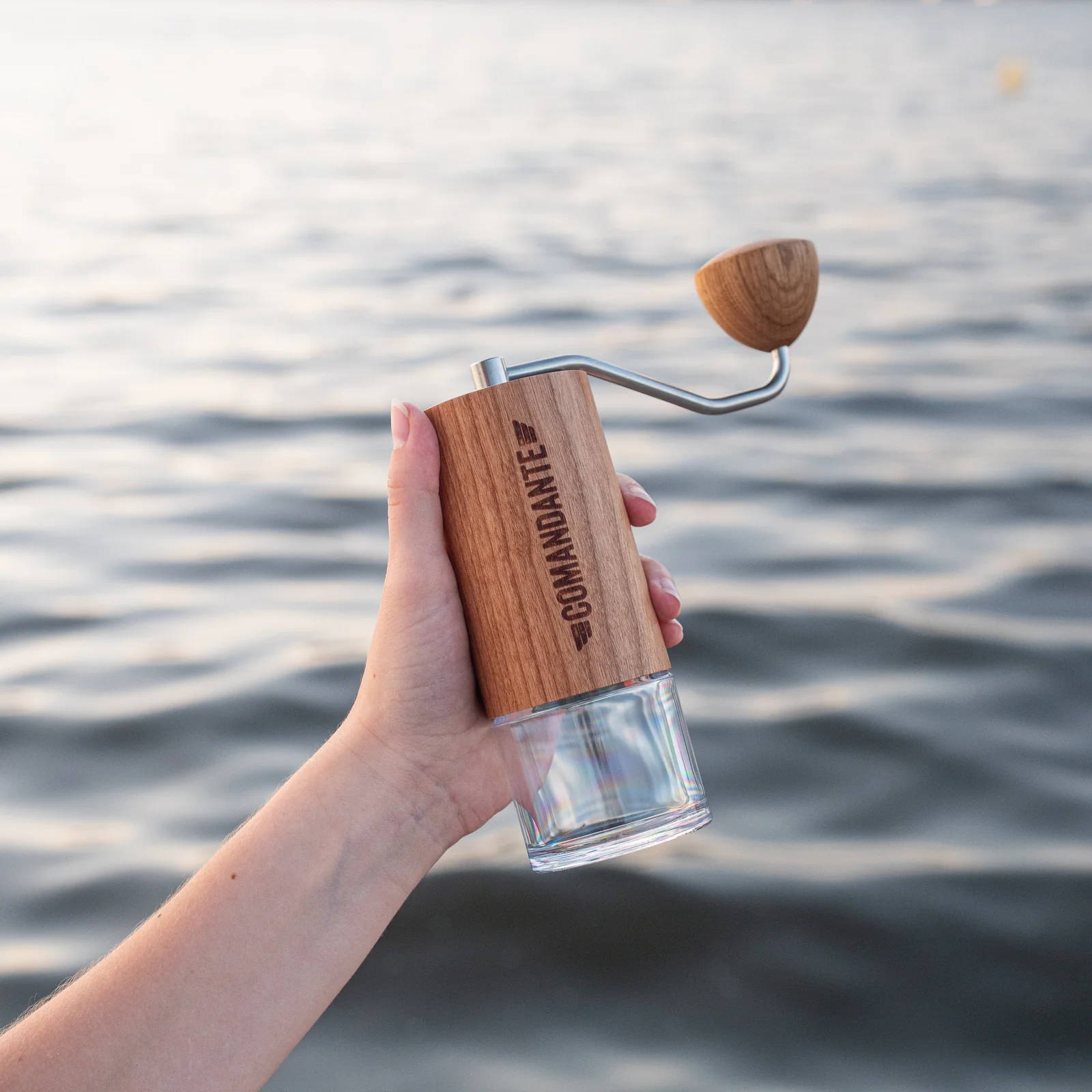
Manufactured in Germany, it enjoys immense popularity in the coffee scene around the world: the Comandante MK4 Nitro Blade. And for good reason. In many respects, it is the gold standard amongst manual coffee grinders on the market.
The grinder’s grind consistency plays a major part in this: if you look at the particle size distribution of the coffee from our test grinders, the exceptional homogeneity of the German company’s grinder is immediately apparent. Manual coffee grinders generally struggle to achieve a consistent grind, particularly at medium to coarse grind settings. If the grinding mechanism isn’t properly secured, larger pieces continually end up in the grounds container without being ground sufficiently. The Comandante produces an impressively low amount of ‘fines’, which is another reason why it takes first place in our hand grinder comparison.
The Grinder is generally well suited to espresso too. However, if you make espresso exclusively, the grind adjustment on the MK4 might be a little too coarse for you and affect your dial-in. For perfect fine-tuning, we recommend the ‘Red Clix’ upgrade for the grinder.
Overall, however, it’s clear that the Comandante remains the gold standard among manual coffee grinders in terms of grind consistency.
What Accounts for this Significant Difference?
The grinder features a conical burr made from high-nitrogen stainless steel, manufactured using a patented process. This stainless steel is not only extremely durable but also has very sharp edges. The edges are even individually re-sharpened. For this reason, the Comandante achieves a more consistent grind than most electric coffee grinders.
The various grind settings can be easily adjusted using a continuously adjustable click system operated by a small wheel on the underside of the grinder. This means the hand grinder offers plenty of flexibility for any coffee maker. Of course, it cannot compete with the wide range of grind settings offered by stepless espresso grinders, but that is not what a manual grinder is designed for. Even though this means you are slightly more limited when it comes to fine-tuning your espresso, we can wholeheartedly recommend it for espresso too, thanks to its otherwise outstanding qualities.
You can also tell the Comandante is in a class of its own when it comes to operating the grinder. A double ball bearing aids power transmission and reduces the effort required. It even makes the otherwise rather tedious grinding process a pleasure. The beans are ground almost twice as fast as with the other grinders in the test, whilst the rotational movement feels much smoother and more fluid. This is partly due to the shape of the handle, which – unlike on other hand grinders – curves towards the centre of the grinder. As a result, the lid of the bean hopper sits particularly securely during grinding, power transmission is enhanced and the grinder sits more comfortably in the hand.
The Comandante’s appeal is rounded off not only by its attractive design, but also by the use of exclusively high-quality materials. The moment you first pick up the hand grinder, it’s immediately clear that you’re holding a professional-grade grinder.
The grinder appears to be very well thought out from start to finish. The 40 g coffee capacity is sufficient for any coffee maker; nevertheless, a second sealable container is included in case you wish to grind coffee in advance. One ground coffee container is made of real glass (amber glass), whilst the second container on the MK4 is made from a special, clear hi-tech polymer (plastic). Comandante introduced this change on the MK4 so that the second, more robust container can be used when travelling.
To clean the grinder, the grinding mechanism can be removed completely with ease. However, thorough cleaning of the bean hopper can prove somewhat more laborious, as not all areas are easily accessible. Adjusting the grind setting is also a little fiddly, as this can only be done from the inside. This minimal extra effort is only worth mentioning, however, because we did not notice any other negative points.
Apart from the price. If it weren’t for that, I’m sure every one of us would proudly have a Comandante on display in our homes. At just over 200 euros, this hand grinder is by far one of the most expensive options on the German market. But it’s also by far one of the best.
Conclusion: The Comandante is certainly not a purchase for everyone, but it is a very high-quality grinder that makes the grinding process a pleasure and delivers results that amaze even its electronic rivals.
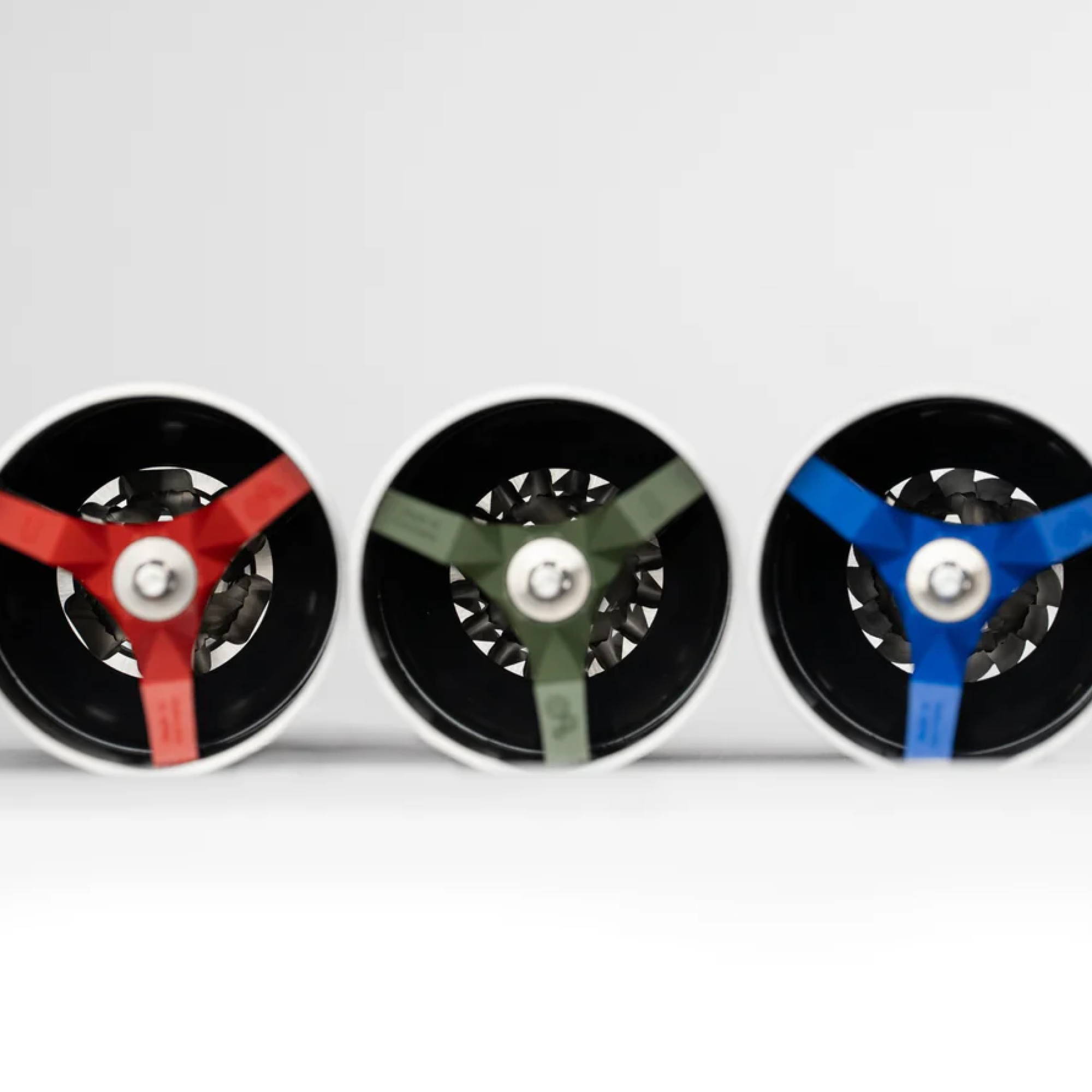
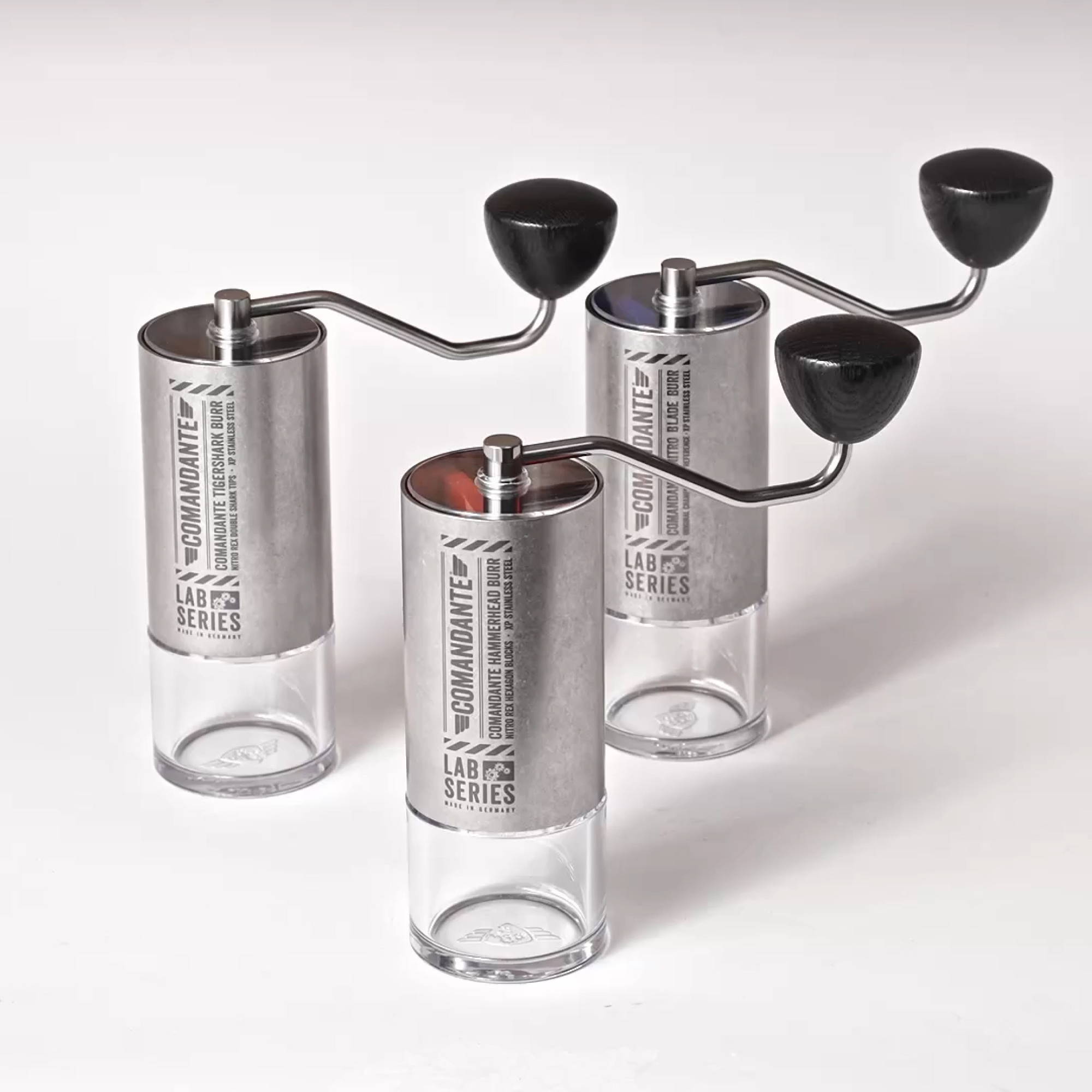
We tested the consistency of the ground coffee using the Keck Sand Shaker.
By using sieves of different sizes, the coffee particles can be separated from one another, allowing you to measure how consistent the grind is for each grinder. To determine the size of the individual sieves, we shook 10 g of coffee in the Keck Sand Shaker until no more coffee particles fell to the bottom of the shaker (approx. 3–5 minutes). When selecting the sieve sizes, it was important to us that hardly any coffee particles collected on the two outer sieves.

Porlex Professional The Best Value for Money
In this comparison, the Porlex Professional came out slightly ahead of the Hario Mini Mill. It delivers a surprisingly consistent grind for its price range.
At coarser grind settings, the proportion of large coffee chunks in the ground coffee is relatively low. Even at finer grind settings, the Japanese manufacturer’s grinder produces very few fine particles. Whilst other grinders we’ve tested perform better than the Porlex in terms of grind consistency, when you factor in value for money, the Professional is simply unbeatable.
The grind size can be easily adjusted using a cross-shaped wing nut. The principle is the same as with the Comandante: the grind size changes with every click. When adjusting the grind size, you should make sure to turn the grinder upside down; otherwise, coarser coffee particles may become wedged in the grinding mechanism and damage it.


During the grinding process, the grinder feels very comfortable in your hand and is a pleasure to use.
The crank mount is slotted, which ensures it sits very securely. The older version of the Porlex had a hexagonal mount here, which became rounded with wear and could no longer be operated. The rubber ring provides even greater comfort, as it makes the grinder significantly easier to grip. Unfortunately, this is not included with the Porlex Tall, which, whilst having a 10 g larger capacity, suffers in terms of ease of use. The larger version of the Porlex is somewhat impractical, particularly for those with small hands. With this model, you constantly have the feeling that the ground coffee container isn’t sitting properly and that you have to hold it in place with the rest of the grinder. This is less of a problem for those with large hands, but extremely so for those with small hands. Furthermore, thanks to its size, the Mini is perfect for travelling.
In terms of build quality, too, the Porlex lives up to its consistently good test results. It features a high-quality, coated ceramic grinding mechanism and is made entirely from stainless steel. The handle is slightly curved to allow for even better power transfer.
The 60 grind settings allow for incredibly precise adjustment, which is a real highlight, particularly given the grinder’s price.
Are there any drawbacks?
We see the Professional Mini’s small 20 g capacity as a minor drawback. However, this is sufficient for most coffee makers, and grinding a second batch isn’t a major extra effort.
Conclusion: The Porlex Professional combines Japanese precision, efficient technology and well-thought-out design. Whether you’re looking for a compact model for on the go or one with a larger capacity, both models deliver reliable grinding quality for a genuine coffee experience, wherever you are. They’re very well built and easy to use. The best choice for anyone who fancies a good cup of coffee but is looking for an affordable grinder. Thanks to the compact size of the Mini version, it’s also perfect as a travel grinder.
Other Grinders Reviewed
For Beginners
Hario Mini Mill Plus
In our value-for-money ranking, the Mini Mill was beaten by the Porlex by the narrowest of margins. It is the cheapest and smallest grinder from this Japanese manufacturer. Although it is mainly made of plastic, apart from the ceramic grinding mechanism, it has a classically stylish look and sits comfortably in the hand. In our view, despite the inexpensive materials, it is better built than similar models because it is significantly sturdier and therefore better suited to long-term use.
If you’re really looking to buy an affordable grinder, you’ll struggle to find anything comparable to the Hario Mini at a lower price.
The 15 grind settings are easy to adjust and the grinding process runs smoothly. Unfortunately, grinding with the Mini takes quite a long time, but then again, you’re paying relatively little for it. Overall, the Hario Mini is therefore recommended as an affordable entry-level option or as a travel grinder, but you shouldn’t have the highest expectations of it. Anyone who usually grinds more than 20 g of coffee should opt for a larger grinder that grinds faster. Otherwise, the grinding process can become a real chore.

Hario Skerton N
The Skerton is the „big sister“ of the Mini Mill. Although it costs only slightly more, it feels higher quality and more robust. It, too, is made largely of plastic, but the collection container is made of glass. The Skerton sits comfortably in the hand and grinds significantly faster than the Mini Mill. It’s easy to operate by hand, but it also has a non-slip rubber base for the glass bottom, in case you prefer to place it on the table whilst grinding.
The Skerton also features a second axle bearing, so the grinding mechanism should be slightly more stable. Unfortunately, however, this isn’t reflected in the grind consistency. The Skerton produces a fairly large proportion of coarse coffee particles. Furthermore, the particle distribution is not as uniform as with the other coffee grinders, and there is a relatively high proportion of coarse particles. Overall, it’s fair to say that the grinding result is poorer than with the Mini Mill. What a shame!
The Skerton also fails to impress when it comes to adjusting the approximately 12 grind settings. Firstly, the top screw must be unscrewed and the grinding handle removed so that the dial for adjusting the grind size can be turned. This dial is securely fixed in place by fitting and screwing on the crank. However, when cranking quickly, the top screw can come loose, causing the crank to come loose as well. Not exactly ideal.
All things considered, the Skerton therefore only comes out on top against the Mini Mill in terms of build quality and grinding speed; when it comes to ease of use and the quality of the ground coffee, both have their strengths and weaknesses. Thanks to its low price, the Skerton also offers excellent value for money, but it is only recommended as an affordable entry-level grinder.


For Advanced Users
Timemore Chestnut C5 Pro
The Timemore Chestnut C5 Pro is a versatile hand grinder for filter coffee, AeroPress and French press. Its precision-engineered S2C grinding mechanism ensures a high degree of grind consistency, resulting in balanced extractions across a wide range of grind sizes. The fold-away crank handle is also practical for everyday use, making the grinder compact and easy to transport. As a result, the C5 Pro offers a compelling combination of ease of use, build quality and grinding performance.
In testing, the S2C-042-III stainless steel burr set, with its „Spike-to-Cut“ geometry, proved particularly impressive: The beans are first cracked and then precisely cut, which reduces fines and results in a particularly clean cup profile. Compared to the popular C3, the consistency of the grind has been further improved, whilst the grinder operates noticeably faster and more quietly. Thanks to the more stable mounting of the grinding cone, the grind quality remains consistently high even at coarser settings for French press or cold brew.
If you’re a pour-over enthusiast or simply appreciate a clear and nuanced flavour profile, then the Timemore C5 Pro is the ideal choice.

Timemore Chestnut C5 ESP Pro
The Chestnut C5 ESP Pro is the espresso-specialist variant of the C5 series. Visually, it differs little from its sister model, but technically it features a significantly finer grind adjustment. The finely graduated click adjustment allows for precise adjustments for portafilter machines and facilitates the exact ‘dial-in’ of espresso. At the same time, the ESP version also benefits from the high-quality build and compact design of the C5 range.
Like the C5 Pro, the ESP version utilises the high-quality S2C-042-III stainless steel grinder, which ensures consistent particle distribution and a clean flavour profile. The key difference lies in the adjustment: with just 0.015 mm per click, the ESP Pro offers twice the precision of the standard C5 Pro. This allows even the smallest adjustments to be made to flow time and extraction – a crucial advantage for discerning espresso enthusiasts. The non-slip aluminium housing and the fold-away handle further enhance the overall impression of high quality.
If you’re looking for a high-precision all-rounder that offers you maximum control, the Chestnut C5 ESP Pro is absolutely the right choice.

Timemore Chestnut S3
With the Chestnut S3, Timemore is expanding its range into the premium segment. Its standout feature is the external adjustment ring, which allows the grind setting to be adjusted quickly, conveniently and precisely. Compared to traditional hand grinders with an internal adjustment mechanism, this noticeably improves usability and makes frequent changes to the grind setting much more convenient. Combined with its high-quality build and powerful grinding performance, the S3 positions itself as an attractive option for discerning coffee drinkers who value convenience and precision.
Inside, the new S2C890 steel grinding mechanism is at work, designed to deliver even greater grinding consistency than previous Timemore generations. The robust all-metal housing conveys a particularly high-quality impression and ensures excellent stability in daily use. The Timemore Chestnut S3 combines precise engineering, high-quality design and ingenious details – from finely adjustable 0.015 mm increments to the foldable handle – and delivers impressively consistent results for filter coffee, although it tends to grind slightly too coarsely for traditional 9-bar espresso.
The S3 bridges the gap between the more affordable C5 models and the significantly more expensive premium hand grinders from other manufacturers. This model is highly recommended, particularly for filter coffee enthusiasts with a slightly higher budget.

For Professionals and Outdoor Enthusiasts
Comandante X25 Trailmaster
With the X25 Trailmaster, Comandante offers a robust, high-end alternative for travel, camping and outdoor use. At its heart lies the same Nitro Blade® grinding technology that has already made the C40 one of the best-known hand grinders on the speciality coffee scene. What sets it apart, however, is the completely newly developed QTP® housing: the patented technopolymer feels premium to the touch, is impact-resistant and weather-resistant, whilst being significantly lighter than the classic Comandante models. Weighing just 420 grams, the Trailmaster is therefore ideal for a rucksack or travel kit.
In practice, the grinder impresses with a very consistent grind distribution across the entire range from espresso to French press. The 30-step grind adjustment offers sufficient flexibility for almost all brewing methods, whilst the included silicone lid reliably protects the beans from dirt and moisture when on the move.
Anyone looking for the renowned Comandante grind quality but needing a lighter and more durable alternative to the C40 will find the Trailmaster to be one of the most interesting premium hand grinders for on-the-go use.