SCA Flavor Wheel: What's the colorful wheel all about?

Coffee lovers will have seen this colorful wheel with its gaps and edges before. In some cafés, it’s even hanging on the wall. But have you ever taken a closer look? We’ll show you what the colors and labels mean.
This colorful wheel has been around since 1995. Since then, it has been the gold standard for roasters, baristas, and all other coffee experts – as well as those who aspire to become one. Roasters, especially those with limited professional experience, use the chart to identify the specific flavors in coffee and espresso blends during cupping. Does a blend taste more fruity or chocolate – more like raspberry or blueberry?
What Defines the Aroma?
However, it’s not just about the taste – it’s also about the smell. Smell the freshly ground beans; notice how the aroma changes as the coffee brews; taste the notes that emerge when you bring the cup to your lips and the warm beverage flows into your mouth. “Aroma” refers to this combination of taste and smell. Smell is crucial, because the nose is capable of detecting much finer nuances than the tongue, which can distinguish only five basic tastes: sweet, bitter, salty, sour, and umami.
The various aromas, ranging from chocolate (delicious) to ash (not delicious), are broken down in the SCA’s Flavor Wheel. The SCA is the Specialty Coffee Association of America, the largest trade association in the specialty coffee sector. The wheel, in turn, is based on the results published in the World Coffee Research Sensory Lexicon by dozens of scientists and coffee experts who have categorized various aromas.
Specialty Coffee for a better tomorrow
How It Works
The structure of the Flavor Wheel is incredibly simple, even though it may seem overwhelming at first glance: The starting point is the white or empty circle in the center, from which you work your way outward step by step. All the flavors that make up coffee are divided into nine basic categories: Floral, Fruity, Green/Grassy, Acidic/Fermented, Sweet, Roasted, Spicy, Nutty/Cocoa, and Other. Even someone who isn’t a professional roaster will be able to determine which of these broad categories the flavors of the coffee they’re currently trying to identify fall into.
It gets more nuanced – and correspondingly more difficult – the further you venture outward, as the breakdown continues. Each basic category branches into a subcategory, which in turn branches into another subcategory, ultimately defining the coffee’s flavors as precisely as possible.
Let’s take the basic category “Fruit” as an example:
Fruit leads to → Dried fruits; Berries; Citrus fruits; Other fruits
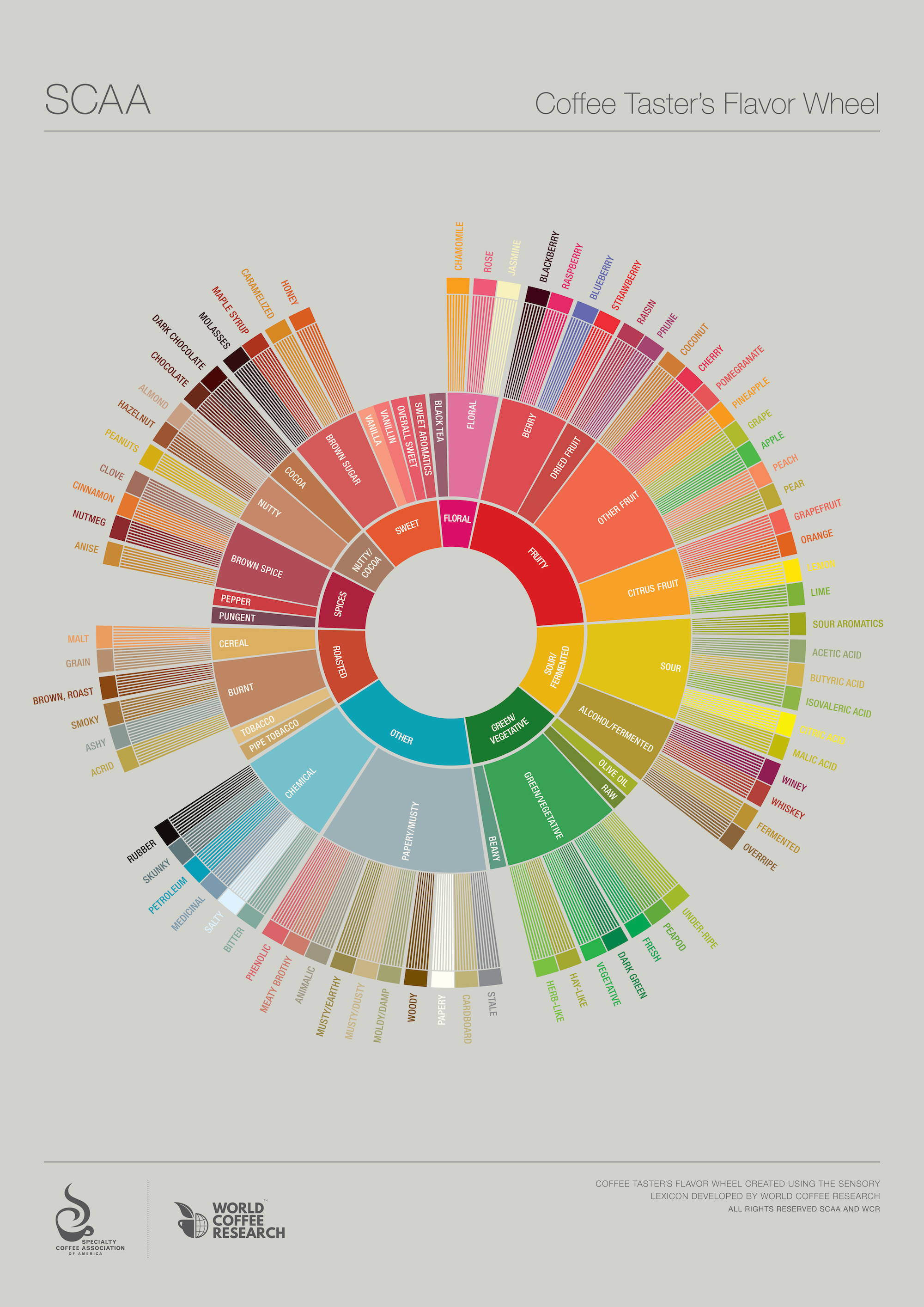
“Citrus fruits” are further divided into: lime, lemon, grapefruit, and orange. If you can pinpoint the aroma here, you’ve at least nailed one aspect of your variety as accurately as possible. Coffees usually have multiple notes. Keep going through the wheel until you feel like you’ve captured your coffee’s entire profile. As you’ve probably already noticed, we list the flavors of our coffees both on the respective product page and on the packaging. Our Limu coffee, for example, tastes like dark chocolate and grapes. Pretty handy, this Flavor Wheel, isn’t it? What did roasters actually do before this invention? In fact, experienced roasters and baristas generally don’t rely on the flavor wheel’s suggestions, which serve more as a guide for amateurs – like training wheels on a bike. Our roaster Robert sums it up succinctly: “People who do this every day don’t need something like that. They have the vocabulary and the flavor notes in their heads.”
Alternatives
The SCA Flavor Wheel also has competitors, such as Counter Culture, which has developed its own wheel that differs from that of its rival. The structure is the same, though the subcategories are divided into slightly finer distinctions, as even a cursory glance reveals. For example, Counter Culture lists “tomato” as a flavor in the “spicy” category – a flavor that is missing from the SCA wheel, along with nectarine and curry. That’s why some coffee experts prefer Counter Culture’s new, more refined wheel.
Author Anette Moldvaer goes even a step further in her “Coffee Book” (Dorling Kindersley 2014) and offers four flavor wheels: one for taste (from apple to cedar); one for evaluating acidity (from mild to aggressive); one for texture (from fine to coarse); and one for aftertaste and finish (from smooth to harsh). But without the fathers, there would be no sons: The SCA laid the foundation and thus paved the way for everything that was to follow.
You can purchase your own SCA Flavor Wheel as a poster here.