Guinea — A Long Road in the Struggle for Recognition

Guinea is greatly underestimated as a country of origin for coffee. Yet the country’s producers have been fighting harder in recent years to carve out a place for themselves in the specialty coffee market—with growing success. Let’s take a look at this West African country.
In William Uker’s book “All About Coffee” (1922, published by Benediction Classics in 2009), Guinea is listed in a table of coffee exporters. Under “Trade Values and Cup Characteristics” it states: “Commercially unimportant.” The country has a turbulent and varied history, not least due to French colonial rule, including in relation to coffee. A lot has changed in 100 years. Guinea deserves even more attention, as the country still has untapped potential—particularly as a producer of Robusta—that can be harnessed on the international market.
In 2022, we added the Djafa to our portfolio—a 100% Robusta single-origin coffee from Guinea with notes of marzipan and nougat. The coffee was grown by a coffee-producers’ group at an elevation of just under 700 meters in the Sengbendou administrative district of the Macenta region and produced by Macenta Beans. Macenta Beans operates washing stations, thereby supporting the farmers with processing. Behind Macenta Beans is Mamy Dioubaté, a native of Guinea who studied in Germany and has lived in Berlin for many years. He began writing his doctoral dissertation on the global coffee value chain, using Uganda and Vietnam as case studies, before founding Macenta Beans in mid-2019.

Marquee Ticker Sanity Awards
Mamy also attributes the fact that Guinea is still underestimated as a country of origin for coffee to the lack of statistics: “We don’t know the exact figures. There are various reasons for this. The most significant is that the government invests very little in agriculture. Guinea focuses on mining, whereas agriculture is economically more important for other African countries. There are many mines here because Guinea has abundant mineral resources, such as bauxite, gold, copper, and so on. The government supports these mines and mining operations. Nevertheless, 70% of the population depends on agriculture. More coffee is produced than is reported. Coffee is transported overland to neighboring countries, which then export it. Senegal, for example, does not produce coffee itself, yet it is often listed before Guinea in lists of coffee-exporting nations. However, the coffee exported by Senegal actually comes from Guinea.”

Guinea doesn’t just export to Senegal and Mali. Guinean coffee is also extremely popular in North Africa, particularly in Morocco and Algeria. During the colonial era, it was imported directly to France, primarily because the quality of the coffee was highly regarded. Guinea was a French colony from the mid-19th century until the late 1950s. For the French, the country was of vital economic importance. After independence, other export routes opened up.
As a coffee-producing country, Guinea suffered from the end of the colonial era, as the subsequent socialist regime under Sékou Touré heavily taxed the coffee sector. As a result, farmers began to switch to other crops. Consequently, the coffee market in Guinea declined. But in recent years, Mamy has observed a welcome and promising shift: “A revival is taking place right now. A trend is emerging. People here want to get more involved. In our country’s coffee history—and not just here—there have been repeated disappointments due to the volatility of coffee prices and the high expectations of farmers, which could not always be met.”
With the growing specialty coffee market, more and more entrepreneurs and producers are taking notice of the potential of Guinea as a coffee-producing country. The region could experience a major boom, primarily due to the growing popularity of Robusta, or Canephora. Guinea’s climate makes it ideal for growing Canephora. However, small quantities of Arabica and Liberica are also produced here, as well as Stenophylla, which scientist Aaron Davis has identified as a beacon of hope in the face of climate change.
Until recently, Stenophylla was considered extinct outside of Ivory Coast, before it was discovered in Sierra Leone and Guinea. In a taste test, 80% of coffee experts could not tell the difference between Stenophylla and Arabica. Stenophylla is more resistant to heat and rain. In an interview with the BBC, Davis summarized: “Our expectations were pretty low. But then we were thrilled that the coffee tasted fantastic. It also has characteristics related to climate tolerance: [Stenophylla] grows in much warmer regions than Arabica.” You can learn more about the plant and its potential here.

The growing demand for Stenophylla and Robusta varieties presents major opportunities for Guinea. For many years, Mamy himself knew nothing about coffee cultivation in his home country. While working at Tchibo in Germany, he was asked one day whether coffee was grown in Guinea. Unaware of the facts, Mamy answered in the negative. It wasn’t until later that he learned the opposite was true. What’s more, his grandmother had even sold coffee. He felt a growing need to learn more about the history of his homeland, especially as it related to coffee: “During my next trip to Guinea, I tried to learn even more. In 2017, I took on a role as a UNDP consultant to gain insight into the practical aspects of coffee cultivation in Guinea.”

Mamy discovered Macenta, a rainforest region protected by UNESCO, whose soil and harvest conditions are among the best in the world for coffee cultivation. In 2019, Macenta Beans was born, a company focused on specialty Robusta. First, however, he had to identify the prevailing problems: “The farmers in Macenta didn’t even know they were producing Robusta,” Mamy recalls. There wasn’t a single coffee washing station in all of West Africa. Therefore, the top priority for Mamy and his colleague Relika Stoppel was to raise money for an initial washing station through a crowdfunding campaign. The funding goal was reached in a short time.
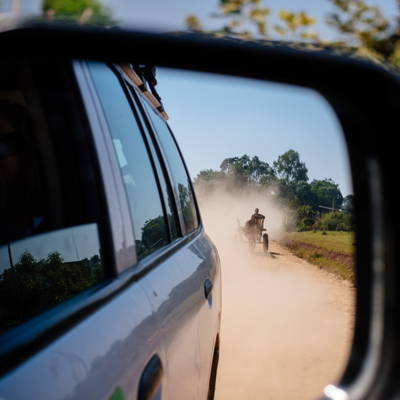
For Mamy and Relika, it was an important milestone in their endeavor to “preserve and highlight the inherent value of coffee” according to Relika, who made a surprising observation during her very first trip to Macenta: “You could see coffee cherries lying on the roads. The coffee cherries are laid out on main roads so they’ll dry quickly, and so that passing cars will remove the husks. This way, the farmers can save on the labor involved in hulling.” This revealed to Relika the vicious cycle: Although the coffee was naturally high-quality, it yielded almost no profit due to a lack of equipment and processing know-how. Consequently, the farmers were frustrated by the meager amount of money they received for their product. That had to change.

The opening of the first washing station in all of West Africa marked an important first step. In 2020, Macenta Beans produced its first coffee. Now we hope that our Djafa Espresso has also helped establish Guinea as a recognized coffee-producing country. The beans didn’t even have to travel very far: Guinea is the coffee-producing country closest to Germany. Ethiopia is a few kilometers farther away.
Current Projects
Learn more
Project Accomplishments
Read more
Impact Report
Learn more
Coffee Circle Foundation e.V.
Read more