Myanmar — Coffee’s slow triumph against all odds

As an exporting nation, Myanmar is best known for its fruit and tea. Tea remains the most important product for farmers to earn a living. However, coffee is becoming increasingly significant. So let’s take a closer look at the country.
Marquee Ticker Sanity Awards
Myanmar holds a special significance for us at Coffee Circle. In 2020, we committed to working closely with coffee farmers in the country. Together with our partners, the German Corporation for International Cooperation (GIZ) and Berlin-based Conflictfood, we set out to support the Jadae Akha Coffee Group, a cooperative in Shan State, in entering the European specialty coffee market. Then COVID-19 and the coup in Myanmar happened, and our plans had to be put on hold temporarily. Nevertheless, we were able to set several things in motion, as you can read in this report.
Shan State is located in the east of the country. It is here, in Keng Tung, that the Jadae Akha Coffee Group harvests its Arabica coffee. Their work is challenging not only due to the volatile political situation, but also because the cooperative is geographically isolated from the rest of the country. At the same time, the region offers ideal conditions for growing high-quality coffee, tea, and a variety of herbs and spices used for infusions, such as ginger. Hardly any farm grows coffee exclusively. Tea and fruit often grow in the same fields.
Specialty Coffee for a better tomorrow
The cooperative has existed since 1994, but it has only been growing coffee since 2012. Just under two dozen farmers work here, all of whom belong to the Akha ethnic minority. To this day, researchers have not reached a consensus on where this ethnic group originated. It is generally believed that they came from the Tibetan Plateau and migrated from there to Burma, Laos, Thailand, Vietnam, and Myanmar. Estimates suggest that around half a million Akha people still live today, most of them in villages located at high altitudes. In Thailand, the Akha are officially recognized as a hill tribe. However, younger generations are increasingly leaving their families, who live in isolated, remote mountain regions, to seek opportunities in more densely populated areas such as cities.
In this DW documentary, you can gain an insight into the everyday lives of the Akha in Laos.
The Akha are a deeply spiritual people: two gates at the entrance to the village are meant to keep spirits away. Certain trees must not be cut down, as doing so is believed to bring a curse upon the entire village. If a woman is pregnant with twins, she and her family are banished from the village. According to Akha beliefs, twins are considered to be the creation of evil spirits. The parents may only return to their village after killing their twins. Funeral ceremonies last for five days. To ensure that the deceased’s family can continue to live in happiness and prosperity, the head of a slaughtered water buffalo is placed on the roof during this time.
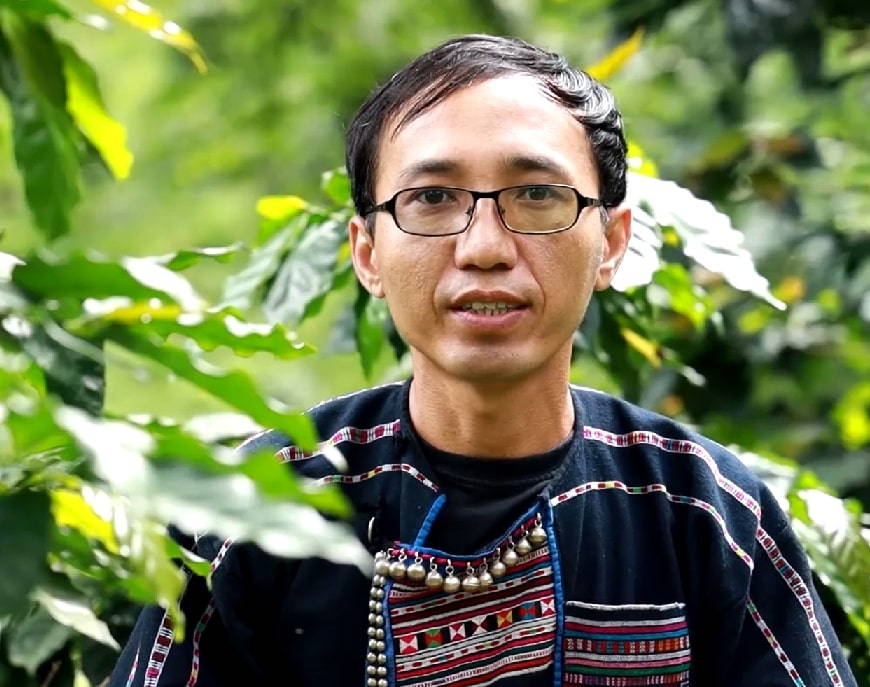
While the farmers of the Jadae Akha Coffee Group are exclusively Akha, many people from other ethnic groups also work for the company in processing and operations. Bu Saw and Ko Thar are not Akha themselves, but as Managing Director and General Manager respectively, they ensure that everyone involved in processing works together smoothly and without conflict. “Members of the Akha in our group are spiritual and worship gods,” says Ko Thar. “But within our culture, there are Christians, Catholics, Buddhists. There are different religions. This does not cause any problems. Certain trees cannot be cut down for religious reasons, but we can teach the Akha how to cut trees while also protecting them.” “There are clear rules,” Bu Saw adds. “The Akha have certain trees that they worship. We cannot touch these trees. We all benefit from one another: we take part in each other’s customs and learn from one another. In our company, we focus on the Akha and make sure that we do not interfere with their traditions. Perhaps that is our secret. If someone wants to incorporate an aspect of their religion into their work, we gently remind them of our goals and mission.”
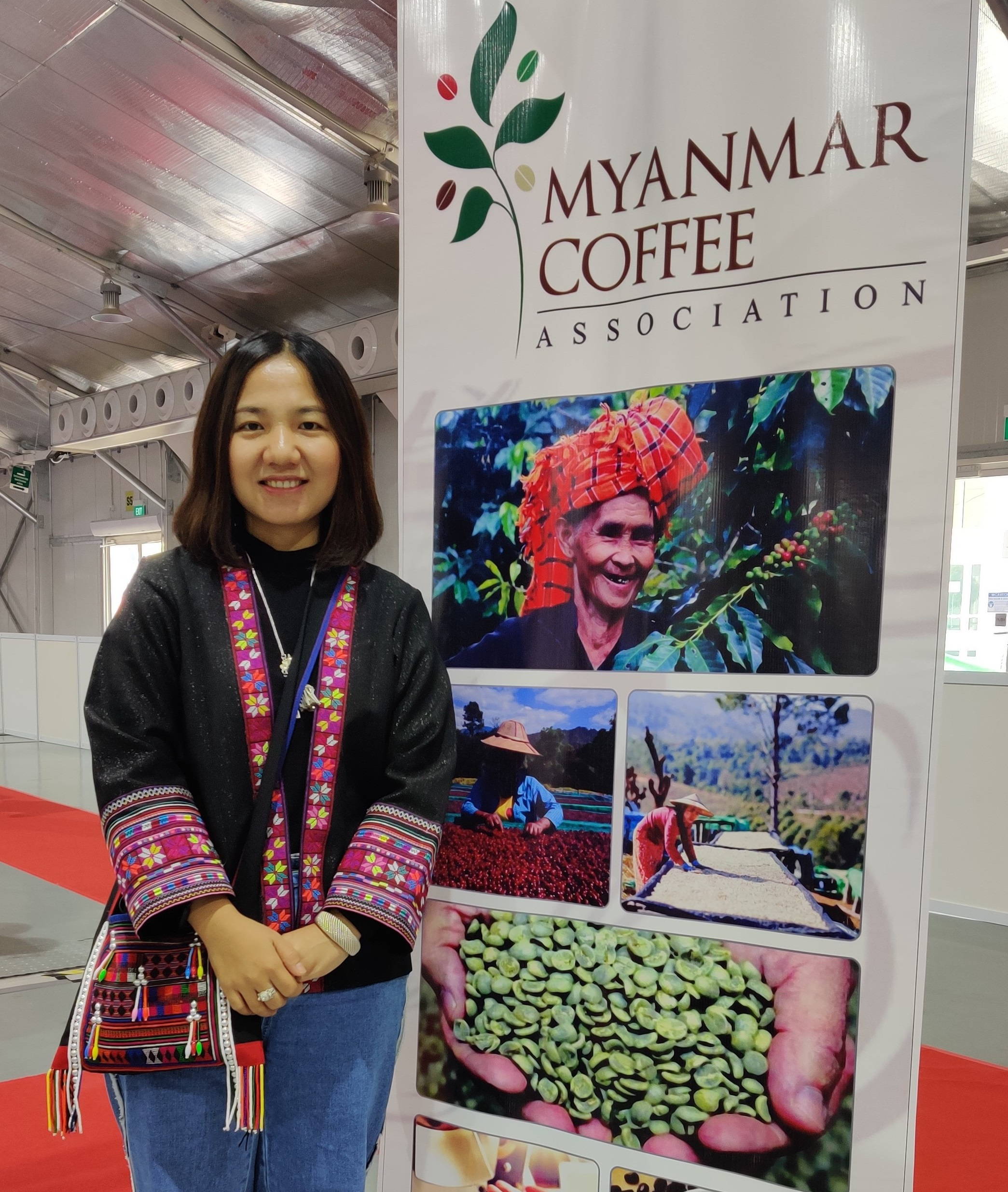
Contrary to what one might assume, “Jadae”, the word in the organization’s name, does not refer to a region. The word comes from the Akha language and translates as “a good place”, “a land of victory”, or “a land of grace”. The Akha believe that the soil on which they grow, among other things, coffee is particularly rich and fertile. Apparently, they are right: the shaded forest gardens at an altitude of 1,200 meters produce abundant yields not only of coffee but also of tea. The coffee farm is located in Upper Pann Lawt, Keng Tung, approximately 8 km from downtown Keng Tung. After harvesting, the coffee cherries are transported by motorcycle to the nearby city, as the narrow roads make other forms of transport difficult. The Jadae Akha Coffee Group’s office is also located in Keng Tung. Several cafés serve the group’s coffee.
In this video interview, learn more about the work and challenges faced by the Jadae Akha Coffee Group. The interview was conducted by Hannes Fendrich (Coffee Circle roaster) and Stephan Eicke (Content Creator).
Even with the support of Conflictfood, GIZ, and us, exporting green coffee from Myanmar remains a challenge. “COVID has made our work increasingly difficult, and the political situation is getting worse by the day,” says Bu Saw. “Due to the curfews imposed because of COVID, it is difficult for us to reach the villages where the coffee is harvested. We have to discuss with the farmers how to get their coffee from the fields to our processing facility. This involves intensive negotiations with the village headman. Sometimes we work late into the evening so that the farmers can bring their coffee to Keng Tung by 8 p.m. and make it back home in time before the curfew takes effect.”

Despite these circumstances, the Jadae Akha Coffee Group is doing well, as Ko Thar and Bu Saw assure us. Listening to their accounts, we find it remarkable that we are able to offer their coffee at all. In addition to COVID-related restrictions, they also face technical and political challenges: power outages are frequent in the region, sometimes lasting up to 48 hours. This makes communication with the farmers even more difficult. When it rains, reaching them is also challenging, as the roads become slippery and almost impassable for motorcycles.

On February 1, 2021, the military in Myanmar ousted the elected members of the ruling party. A military regime was subsequently installed, and a state of emergency was declared. This made not only trade but all areas of life in Myanmar considerably more difficult. GIZ had initiated the first quality training sessions for farmers in the region, but had to leave the country shortly afterward. Since then, the Jadae Akha Coffee Group has been trying to organize seminars and training programs independently. This is made more difficult by the unpredictability of the military government, as rules and laws are constantly changing, sometimes within 24 hours, according to Bu Saw: “The authorities change their requirements every day, so we always have to check carefully what is currently in effect. This makes long-term planning impossible. Our day-to-day operations continue as normal, but there is not much we can do.”
Although the government works with the national coffee organization, it only supports growing regions in the north of the country that have modern equipment and the capacity to produce larger quantities of coffee. “I recently saw,” says Bu Saw, “that a government official traveled to the north to arrange the construction of a factory with a coffee farm. But we are too far away from that region. We receive no support from the government.”
From the perspective of the Jadae Akha Coffee Group, the government’s focus on the northern regions is detrimental. From the authorities’ point of view, however, it is understandable. Coffee production in Myanmar has grown significantly in recent years, largely because the potential of the north has been recognized: thanks to the high elevation, nutrient-rich red soil, and sufficient rainfall, the region can produce large quantities of high-quality Arabica beans.
But Arabica is not the only type of coffee grown in Myanmar. While Arabica accounts for two-thirds of the annual harvest, just under one-third consists of Robusta. A small remainder is made up of Liberica and Excelsa, particularly resilient varieties that are only produced in small quantities worldwide. Around 80% of the coffee in Myanmar is grown on small farms and processed using only rudimentary methods, without the use of technical machinery. For example, the coffee cherries are hulled by pounding them.

With the support of organizations such as GIZ and through their own efforts, the Jadae Akha Coffee Group has worked intensively to share knowledge and expertise with farmers, including through quality training. These initial efforts have already borne fruit, as you can see for yourself when you try our Jadae coffee: the Arabica produced by the Jadae Akha Coffee Group is a high-quality, full-bodied coffee that is extremely popular with our customers. We are so convinced of its quality that we are doing everything we can to continue working with the Jadae Akha Coffee Group despite all the obstacles. We are already looking forward to the next shipment of green coffee.
Despite all the challenges, Bu Saw and Ko Thar remain optimistic: in 2021, they produced five tons of coffee. They aim to increase this volume over the next two years. We will continue to support them.